The Origins of Fable
"Would it be possible to add skyscrapers and cars to it?" was probably one of the more unexpected pieces of publisher feedback we got when pitching the game that would eventually become Fable.
After a hiatus of 15 years, this year Microsoft will launch the latest game in the Fable franchise. As someone who was intimately involved in the original trilogy (yes, I heard there was the other one but, like the sun or Mrs Brown's Boys, I can't look directly at it), it got me thinking about the development of the original Fable back in 1998, and how we got signed with Microsoft in the first place. I kept most of my notes and, while the origin of Fable is well documented online - for example here, here and most recently here - there are various details I've not seen mentioned before.
Firstly, a bit of background.
Big Blue Box

Like many socially awkward children in the 1980s, my brother Dene and I had been building games together since childhood, and had always dreamt of starting our own games studio. In 1998 we'd just finished working on Dungeon Keeper and, together with our close friend Ian Lovett, founded Big Blue Box Studios. Peter Molyneux had recently left Bullfrog to found Lionhead Studios, and he offered to help us get started; in return for a minority share in the company, Lionhead agreed to use Peter’s fame and influence to help find funding, negotiate deals, and provide advice. We gladly accepted.
Dene and I had scrabbled together some savings, but we knew it could take months to get publisher funding. Thankfully, our needs were small; Peter was kind enough to loan us his home office, and I dusted off my copy of Roadkill For the Aspiring Chef. Here we are, on the balcony, sporting a 'hi, we've come to install your new surround sound system?' look that was, in hindsight, a curious choice.

Full of enthusiasm, ready to change the world, we whittled down our list of game ideas and settled on the one we felt would resonate with audiences and publishers alike.
That game was… Wishworld.
Wishworld
Wishworld was inspired by Julian Gollop’s excellent Chaos, a game we played obsessively as children. Wishworld took elements of this and combined it with inspirations from Magic Carpet and Starsiege: Tribes, with the goal of creating a realtime, third-person, multiplayer, fantasy action/strategy game. Powerful wizards would battle against each other, casting spells, summoning creatures to build an army, and warping the very fabric of the landscape they were battling on.
We immediately began building out the first playable prototypes of Wishworld. Prototyping a 3D game in 1998 could be fairly challenging, as there weren’t any off-the-shelf game engines of note you could start with, and everything had to be built from scratch in C/C++.
Here are some old screenshots from one of the early builds:
 |
 |
|---|
It was fully multiplayer, with terrain deformation, combat and spells. It probably doesn’t look like much, but if you can see past the low-res textures and chunky trees, you can see the beginnings of the terrain system that would eventually power Fable 1.
Pitching
The next 6 months were a blur of publisher meetings. Pitching games is never easy, and in our case all we had was a high level design doc, a very early prototype and our boyish good looks. My memories may have been tinged by the anxiety I felt at the time, but I mostly have a hazy recollection of Dene and I giving the high level pitch while gyrating slowly against a pole in nothing but our underwear, while surly businessmen threw dollar bills and peanuts at us shouting 'dance monkey-boy dance'.
Our energetic twerking was eye-catching enough for several publishers to express an interest, one of the first being Interplay. We pitched to them 3 or 4 times over the course of a few months, and each time the audience was bigger and more enthusiastic - they really seemed to get the game we were pitching. "This is going much better than I expected!" I remember telling Dene one evening over a plate of Squirrel A La Francaise. "They love Wishworld! We'll be signed in no time!"
Two weeks later, they stopped responding to our emails.
Thankfully, we’d also been building a relationship with Activision, although our conversations with them had a very different energy:
Activision: We love your game! Combatants using enormous powers to tear up the landscape? Wonderful, we’d like to sign you up!
Us: That’s amazing! Thank you! Squirrel tastes awful.
Activision: Eh? Anyway, would you be open to some creative suggestions?
Us: <nervous> Of course.
Activision: We love your rendering engine technology. We were wondering, would it be possible to add skyscrapers and cars to it?
Us: <blinking> Erm. Sure. But that doesn’t really fit with the theme of wizards and trolls.
Activision: Ah, well indeed. We want to modernise the theme a little bit - fantasy doesn’t really sell. Wizards are basically super heroes, right? And skyscrapers are like mountains, but modern?
Us: So what, you want us to put in a city and cars and turn it into, what, ‘Wand Theft Auto’?
Activision: Exactly - great name! We knew you guys would get it!
Finding the middle ground between "Epic Wizard Battles" and "Superman - the GTA Years" was difficult, but we were swiftly approaching the dessert section of my cookbook, and keen to avoid the gamey delights of Badger Trifle.
Activision’s key sticking point was the fantasy setting, so we initially tried to bring the game's fantasy elements into a modern day context. We pitched ‘Merlin’, where an inexplicably buff version of the famous magician of Arthurian legend used his powers to defeat baddies in modern day New York. We quickly followed this with ‘Thor’, where an inexplicably buff version of the popular god of Norse mythology used his powers to defeat baddies in modern day New York. Clearly we were way ahead of our time.
Activision weren't convinced by either of these, but felt that the 'mythological gods' theme from the Thor pitch was sufficiently distant from fantasy as to not be commercial suicide, and we agreed to compromise on a version of the original pitch of Wishworld, framed around battling deities. Here’s one of Dene’s design overview docs.

After nearly a year we were ready to sign; and then something unexpected happened.
Interplay announced their new game, Sacrifice, developed by Shiny entertainment. It was a multiplayer realtime battling game, inspired by Julian Gollop’s ‘Chaos’, where powerful wizards would battle against each other, casting spells, summoning creatures to build an army, and warping the very fabric of the landscape they were battling on.

You can imagine the reaction we had to this. If you can’t, picture the scene from 'Seven' when Brad finally finds out what’s in the box.
<whisper> My metaphorical lawyer is very keen that I emphasise that I don’t think anything untoward happened here. My understanding is that Sacrifice had already been secretly in development for 6-12 months, so this was either a horrible coincidence, or Interplay was merely concerned that we were building a competitor product. And to be fair, we were all riffing on the same inspirations, like Chaos. </whisper>
This felt like a devastating setback. Peter pointed out it would be next to impossible to sell Wishworld to journalists as a new concept, and strongly encouraged us to see if we could use the tech we had built to pivot into the next game on our list.
That game was something we'd thought about as children while living in Gibraltar, and had planned as our second game as it seemed too ambitious as a debut title. It was “an RPG set in a simulated world”, which we had always called 'The Game'.
(I never said we were good at names; this is why my children are called "Primary" and "Backup".)
‘The Game’
Dene and I had spent 4 years of our childhood living in Gibraltar. Gib was a curious place in the 1980s; thirty thousand people, many of whom were from military families, living in a peninsula measuring 2.6 square miles. For a British outpost it was curiously isolated from ‘British’ culture - obviously there was no internet, but even physical post would take 6 weeks to arrive from mainland UK.

The only English-language TV channel in Gibraltar ran for 3 hours in the evening, though not on Wednesdays as that was ‘gambling’ night, with a live feed from the Casino. During these 3 hours it broadcast an eclectic mix of North American TV shows - LA Law, Equal Justice, Twin Peaks, America’s Top Ten with Casey Kasem, and Jim Henson’s The Storyteller.
Demonstrating the tremendous influence of TV on young minds, over the next few years I developed a strong desire to be a barrister, a lifelong fear of owls, and the ability to break into a Paula Abdul dance routine on demand, this last of which would become surprisingly useful in later years during publisher pitches.
For many, Gibraltar’s clear advantages of sun, sea and community would have more than offset the cultural quirks, but the virtues were rather less apparent if your main interests were being indoors, playing computer games and avoiding eye-contact. We spent ever more time retreating into alternate worlds, through games like Ultima IV, Dungeon Master, Lords Of Midnight and DragonTorc.
 |
 |
|---|
 |
 |
|---|
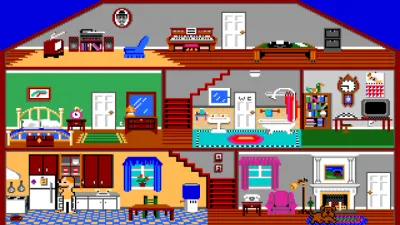
And we were equally fascinated with games that demonstrated the early promises of AI and simulation. Games like Nethack, Little Computer People, the aforementioned Chaos, and Sim City promised a Tron-like future where you could fully immerse yourself into an open-ended digital simulation.
 |
 |
|---|
 |
 |
|---|
I was 13 or so, watching Dene playing Ultima when we started discussing ‘the perfect game’. It would be a fantasy game where you could do anything you liked - go fishing, get married, get a job, become a criminal - and where there would be infinite adventures to go on. It was a game idea we just kept adding things to, and we both agreed that, if we ever had the opportunity, this would be ‘the one’.
To be fair, amazing ideas are easy when you're young; the same week we had designed a car that could talk and transform into a robot, a solar-powered flying deck-chair that could fire rockets when under attack, and jam-flavoured butter for people in a hurry at breakfast. But this particular idea stayed with us (and indeed, Dene has continued this work with his most recent love-letter to Ultima, Moonring).
‘The Storyteller’ was hugely influential for us, and we started imagining ‘The Game’ within this cosy world of dark fairy tales, folklore and European fantasy. Later on, films like Labyrinth and Sleepy Hollow would be added to our internal mood boards.
It was this idea that we now found ourselves turning to 10 years later - a roleplaying game inside a simulation, set in the world of a Grimms' fairy tale, with Wishworld’s terrain rendering technology at its core.
Heroes
So in late 1999 we ditched Wishworld and shifted focus to ‘The Game’. Dene began sifting through various ideas we’d collated throughout the years to build the pitch document, while I focused on both building the technical prototype, and the early chapters of my new book, Stretch Your Funds Further By Cooking with Tripe.
I’ve got some old versions of these design docs, but suspect Microsoft would have opinions about me sharing them; so in lieu of that I have some photos of Dene’s early mad scribblings.
 |
 |
|---|
We renamed the game and, as well as again demonstrating our keen eye for a catchy title, we ended up with a logo that would be the envy of any self-respecting 1970s prog-rock band.

Desperate to get signed and move on from a largely offal-based diet, we ran this initial pitch past Peter. Getting hold of Peter was often a challenge - he and Lionhead would be increasingly busy with their own games for the next few years - but he found some time out from crunching on Black & White and was supportive of the new direction.
His main piece of feedback was to emphasise the ‘simulation’ angle of the game strongly in the pitch. We’d been worried about putting publishers off with another one of our weird game designs, so we found this reassuring.
He also suggested dropping the ‘fairy-tale’ theme, believing it would put off US publishers who might interpret it as ‘Disney’ rather than ‘Brothers Grimm’. This was something we resisted - after 10 years of seeing this game through a Henson lens, we were committed to it.
We were getting to the point now where we needed to start pitching to publishers like Activision and EA. I was busily scrubbing my thong in preparation, when Peter mentioned that a new publisher had expressed an interest - Microsoft. We’d heard rumblings about them making a console, but hadn’t taken them entirely seriously. What would the purveyors of spreadsheets know about games?
As it happens, loads.
Microsoft
We met with Microsoft a few weeks later, and they were easily the most capable and knowledgeable publishing team we’d met with so far. This was presumably partly because many of them had been freshly poached from Nintendo and brought with them decades of experience. They were also genuinely passionate about making the Xbox a success, and importantly had a clear vision for where they wanted to take it, which is harder to say of Microsoft in 2026; I very much hope they rediscover their vision soon.
Crucially for us, they had an RPG-shaped hole in the first party portfolio, and were happy with the ‘folk-tale’ setting. This allayed Peter’s concerns somewhat, although he remained curiously averse to the theme throughout.
A few weeks later, Microsoft’s Xbox leadership team - QA, production, marketing and development leads - flew in for a final pass of due diligence. There were several days of intense talks and probing questions about the game, during which we bonded quite strongly with the Microsoft team, and then we were signed. Everyone was in good spirits, and on the last day we all went out for a ‘signing celebration’ dinner - which is when we nearly managed to bugger things up.
At some point towards dessert someone from Microsoft asked me and Dene what our silliest game idea was. Relaxed, off-guard, and in a somewhat irreverent mood we both remembered a game design we’d come up with when we were younger:
Dene: Well, that would have to be…
Dene and Simon: <in unison> Comedy Crucifixion Simulator!
Dene: <laughing> So imagine a game a bit like space invaders.
Simon: But at the top of the screen you’ve got a giant crucifix, with someone struggling on it.
Dene: He’s tied around the waist, but he won’t keep still, he’s waving his arms and legs all over the place.
Simon: He doesn’t want to be crucified, who would?
Dene: And at the bottom, you’ve got a nail gun. You fire nails up the screen, and whatever you hit gets pinned in place.
Simon: You get bonus points for pinning him down in funny positions.
<pause>
Dene: It could be a fun little Easter game?
Even accounting for British humour, it remains unclear to me why we thought 'comedy edgelords' would be a good look at an important business dinner, and I still haven't forgotten the increasingly horrified expressions of our American colleagues. Mercifully someone changed the subject, and our potentially blasphemous cultural faux-pas was never referred to again.
Ideas Are Easy
And this is the origin of Fable!
Except it's not, really, it was just the story of how we had a nice idea and got funding for it. Turning an idea into something that you want to play for multiple hours is where the real creativity is needed. The art style, mechanics, combat system, creatures, characters, story and the world of Albion - these would all be built out over the next few years by the team at Big Blue Box and, later, our colleagues at Lionhead.
Inspiration would come from many places, some obvious, some less so.
For example, we wanted to add Hobbit-like riddles to the game, and spread them around the world. We were extremely bored of static human NPC quest-givers, and wracked our brains to find something more interesting. Somebody re-watched Labyrinth one weekend and was reminded of the passive-aggressive door knockers - and Demon Doors were born.
 |
 |
|---|---|
| Demon Door | Labyrinth Door |
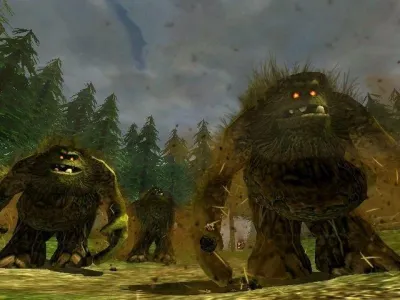
Similarly, Trolls were obviously partially inspired by Norwegian mythology, but also by Ludo in Labyrinth.
 |
 |
|---|---|
| Trolls | Ludo from Labyrinth |
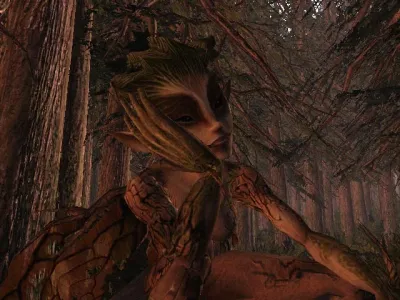
Nymphs were initially lifted directly from Nethack, and in their first incarnations they stole things from the player, but at the time we couldn't find a way to make it not just incredibly annoying. But we loved the way they ended up looking.
 |
 |
|---|---|
| Fable Nymphs | Nethack Nymphs |
We wanted to add a classic fairy-tale 'hobgoblin'-like creature. Someone joked that we could call them Hobbes Goblins, after Thomas Hobbes who famously wrote that life was "nasty, brutish, and short". So, never ones to leave a pun languishing, we called our goblins 'Hobbes', and made them unpleasant, vulgar and somewhat vertically challenged.
For our werewolf-like creatures we wanted an original name. Dene arrived one morning and excitedly told us a name that had come to him, seemingly from nowhere, while he was driving - Balverines. It was a great name and we used it, and it was years later that he realised his morning commute took him past this road:
 |
 |
|---|---|
| Balverine | Balvernie |
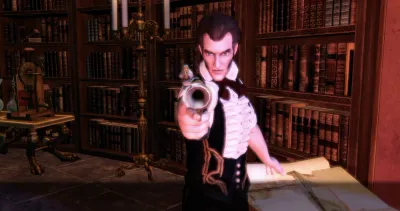
Similarly, I was driving to visit Dene during Fable 2 and drove past this:
 |
 |
|---|---|
| Lucien | Lucien Road |
It's possible that more of Fable came from Dene's misfiring synapses than he thinks; I recently drove along his old commute and saw this...

What Are Origins Anyway?
There is a popular romantic notion that 'ideas' manifest themselves to singular visionaries; that individual geniuses are behind anything worthwhile. I suspect this notion is largely perpetuated by people with large egos, and lazy journalists. Certainly, it's not what happened with Fable; time did not stop while someone stared moodily at a ruined castle and thought 'ooh, you know what - I've just thought up a game about chicken chasing.'
Like most ideas it evolved from a series of random influences, conversations and events, and gestated over 10 years. It was a combination of weird Gibraltarian TV scheduling, Tim Burton, Brian Froud, Jim Henson, David Lynch, Monty Python, a pitch pulled together in haste after 12 months of failed publisher meetings. It was turned into something real through long hard work, by a team of passionate creatives over a long and very crunchy development period.
Warren Spector once wrote that 'teams make games, not individuals', and never was this more true than with Fable.
I very much hope that the team working on the new Fable have as much fun making their version as we did ours. And, if you're reading, should you ever run short of ideas, take my advice - have a glass of sherry and browse Google Maps for a bit, and see if anything occurs the next day.
- ← Previous
Emacs, snakes and camels